
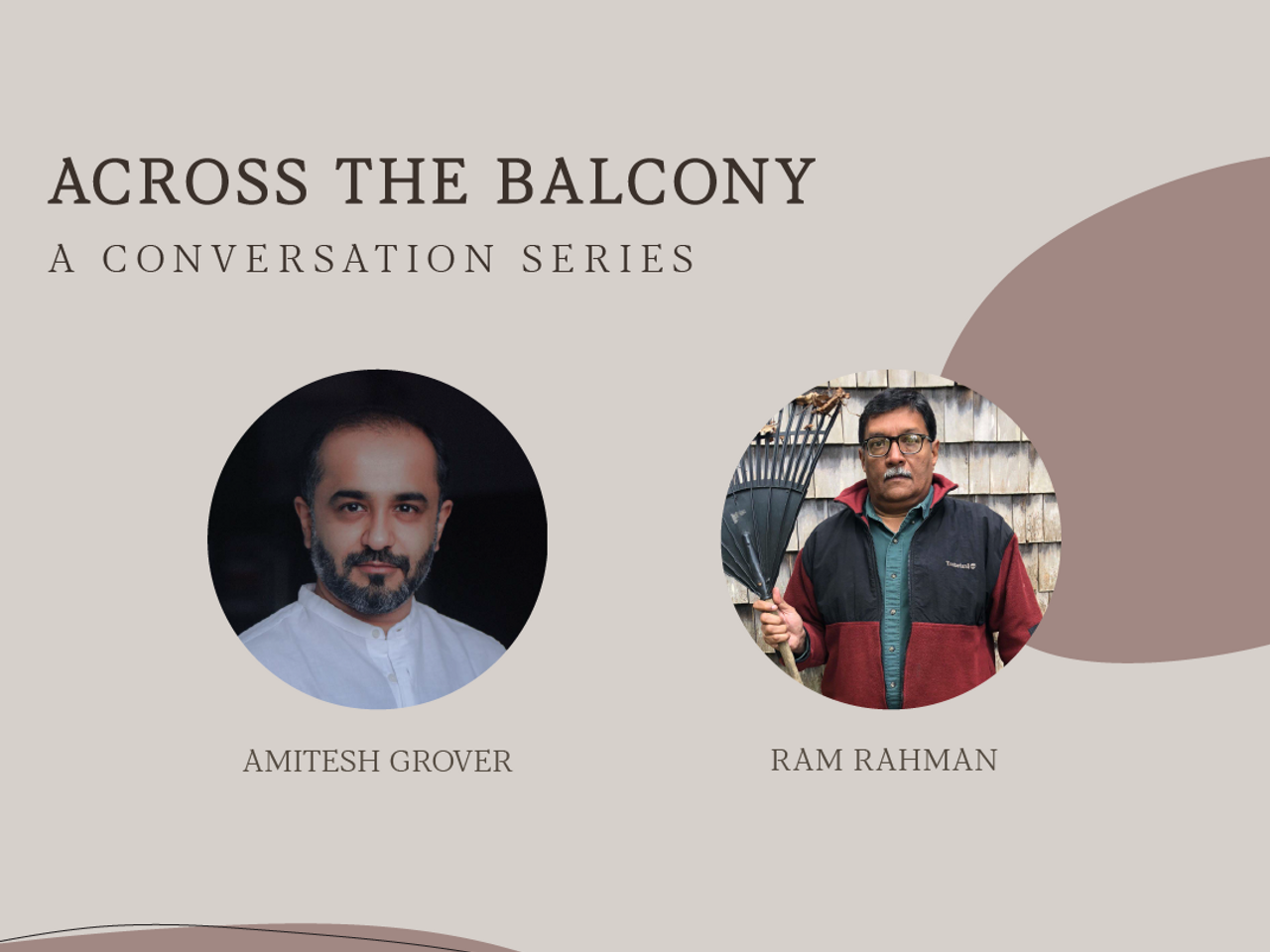
Amitesh Grover X Ram Rahman
Ram Rahman (RR): Amitesh, your project has two parts. One, the imageless frame with has the text THAT IMAGE and a few words which refer to ‘that image’, and then a blog text series ruminating on the strange happening as images begin to mysteriously disappear from our lives and memories. Together these bring up questions of the ‘truth’ the still image represents. How meanings change over time, and how memories are contained, changed or lost as readings and contexts change. The project is fascinating as there are no images, but the intersection of language and language structure with the image is your field of provocation. I post some of your responses below:
Amitesh Grover (AG): I'm not a trained photographer at best an amateur. I’m interested in the photograph as a conceptual enquiry - what is a photograph. I never imagined that I would be creating a visual series. in my conversations with them I what are interested me was that the biennale the third edition especially was open to a philosophical enquiry of what does a photograph mean in todays age where we are inundated with visual information so whether on our phones with their Instagram, Pinterest, Facebook and with our own private photo albums in our phones to analogue family albums, we seem to be surrounded by billions and billions of images. it's quite hard to imagine a world without and that was for me the starting point to think about what does a photograph mean to me and it started from this personal moment in the struggle that I usually have when I want to search for the photographs from years before and I know that I am recollecting it in a certain way in my head. But that doesn't ever help me find a photograph because the way I am recollecting it in my head is not actually what the photograph is in its visual information. I remember photographs with a certain memory associated with that photo which may not be in the frame of that photo. And that's that's because I'm not a visual person in the sense that I don't associate structures to photographs but I do associate memories and other kinds of sounds and conditions within which a photograph was shot.
One of the ideas in my manifesto is about the anxiety of living in the world full of images and the text that I wrote for the Biennale is somehow a subconscious expression of getting rid of that anxiety the text for me gives the space to breathe to say that we are not there, we don't know how images disappeared but they did but it and the world is open again and so that so that text came out of that. I am writing Fabular texts. A lot of the writing that I've been doing recently proposes contemporary fables or or futuristic fables and so when the curators of the Biennale asked me to write something for the Biennale I was very happy because this is a fable that I have been also thinking about - it's almost a response to the more popular kind of sci-fi that's going around in which people lose their vision in the future. There is this mysterious disease that affects people and they begin to lose their vision - that’s not a fable we were going after - we would really lose our vision when we lose images, when it is impossible to capture life. And that for me also connects to the tension between memory and image - after all what is an image ? is it a substitute for memory and that is something that I am not convinced about - I do have to struggle I'm always searching for my memory in the photographs
I'm coming from the outside I'm looking at the history of photography and also read images that have been deemed as being important in history and trying to sort of do away with the image and to somehow evoke it through text and that is already as an outsider to this field that is a kind of iconoclastic gesture that I am already offering to it. The one with the painter - the famous Dali photograph has been very close to my heart because of the performativity that is in the series of the the making of the final photograph that they achieve. In referring to that image I am also beginning to refer to photography as performance and there are a few others that are now going to be released there in the coming week where where I would like viewers to consider photography not as evidence, not as something that happened, but as something that was made to happen only for the photograph. I think by doing that I am also inviting viewers to consider - how could this be a photograph - it does sound like an impossible photo to click. I'm also expecting viewers to actually copy paste the text in Google and search for it.
Similarly there is of course the 1958 photograph of Secunderabad (Lucknow by Felice Beato) the the skull’s of Indian soldiers at Secunderabad which is again an iconic image but as we now know that it was staged the skulls were collected not necessarily of Indian soldiers in the stage photograph by a British photographer, but it entered history erroneously.
We are living in a world in which it's up it's become very important for artists to distinguish between fiction and fakeness. We are not able to separate fiction from what is definitely untrue. We are living in the age of conspiracy theories, the age of fake news and often what is proposed as a corrective measure is turning to ‘truth’ - turning to facts, to data and statistics. As an artist I would turn to fiction and I would create more fiction to be able to counter fake news. There is a difference between fiction and fake news. Fiction for us opens the space to consider what truth might be. Which truth does not. I don’t think the job of photography in this time is to create that fiction. Photography over the 20th century has been understood to be evidence. it has been it's been submitted as evidence in courts. The whole system of faith in CCTV cameras comes from Faith in photography to capture reality. I militate against this because CCTV cameras do not capture for me what is the truth of the situation. They do capture an action. To imagine the truth of the situation I would have to create fiction around it.
RR: Would you create a text about an image which does not exist?
AG: There already are a couple there but I am mixing it up in the series. I am every now and then writing something and writing an image which perhaps only my mind and it really does not exist.
Speaker Bio's
Amitesh Grover
Instagram: @amitesh.grover
website: https://amiteshgrover.com
Amitesh Grover is an award-winning interdisciplinary artist. He moves beyond theatre into installation, video, digital and text-based art. His work delves into themes like the dyad of absence/presence, the necessity of remembering, and the performance of resistance to keep on living. He is the recipient of MASH FICA Award, Prohelvetia Arts Residency Award, Bismillah Khan National Award, Charles Wallace Award, and was nominated for Arte Laguna Prize (Italy), Prix Ars Electronica (Austria) & Forecast (HKW, Germany). His work has been shown globally at venues like Southbank Centre (U.K.), Arts Centre Melbourne, MT Space (Canada), PACT Zollverein (Germany), National Theatre Vilnius, Belluard Bollwerk International (Switzerland), The Hartell Gallery (U.S.), and in India at FICA, Kiran Nadar Museum of Art, The Shrine Gallery, VAICA Video Art, among several others. He has curated for ITFoK (Kerala), Ranga Shankara (Bangalore), and Serendipity Arts Festival. He studied at University of Arts London, and teaches and writes on performance as well.
Ram Rahman
Instagram: @ramrahman2016
Ram Rahman is a photographer, artist, curator, designer and activist. He initially studied physics at the Massachusetts Institute of Technology and later completed a degree in Graphic Design from Yale University’s School of Art in 1979. Architecture is a prime subject of a large part of his works. He has exhibited in individual and group shows in India and around the world. Amongst the shows Rahman has curated are Sunil Janah Vintage Photographs at the NGMA, Mumbai, 2015, Delhi Modern: The Architectural Photographs of Madan Mahatta at Photoink, Delhi, 2012, Heat – Moving Pictures Visions, Phantasms and Nightmares at Bose Pacia, New York, 2003 and so on. Rahman is one of the founding members of the Safdar Hashmi Memorial Trust (SAHMAT) in New Delhi.