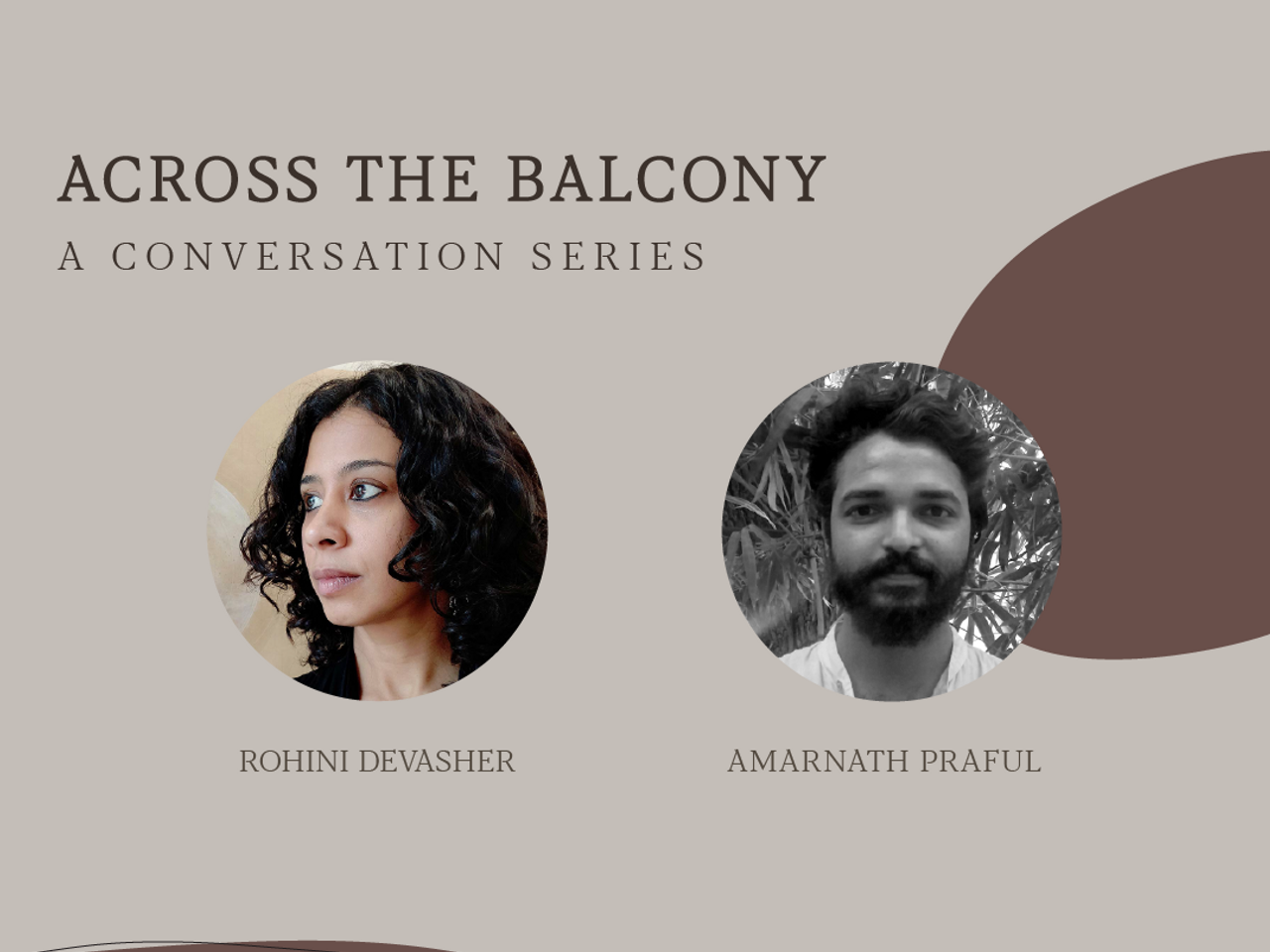
Roshini Devasher x Amarnath Praful
The Conversation
Amarnath Praful (AP): I am quite fascinated to know your earliest impressions, events, memories that might have shaped your interest in this specific work and your larger practice which involves looking at the sky and infinity.
Rohini Devasher (RD): I don’t remember any particular event but it was an interest in science fiction and fantasy which continues to this day. One of the things that much of science fiction and speculative fiction asks is, what if? And that question offers interesting answers. I was in my first year at the college of art and a friend and I were both looking for a science convention or a club in the city. We didn’t find that but instead found the AAAD, the Amateur Astronomer’s Association, New Delhi. That’s how that conversation began and developed into a hobby - over chai on Sunday’s, star parties, meteor hunts etc. It wasn't until a decade after in July 2009 - during a total solar eclipse that I realized that I could bring this into the fold of my practice. That initial research was also supported by the City as a Studio Fellowship at SARAI, CSDS.
At the time I was working with largely print/object-based work and this was very different. It was about working with people's experiences and one's own experience. This work continues till today.
AP: Then you later go and work with Amateur astronomers in your projects..
RD: Yes - because I was also an amateur astronomer I was interested in trying to understand why they do what they do, what draws them to the night sky. With some people like Ajay Talwar, who was somebody I was in awe of and still am, those initial conversations have grown into deeper collaborations. We have worked on several things together.
AP: In your work, especially with regard to the essay format - you take up the role between a scientist, amateur historian, and observer. What do you think the artist’s role is in this kind of work where there are adjacent knowledge systems and communities such as scientists, amateur astronomers involved?
RD: Do you mean the roles that I play within this system or the difference of response or point of view between that of the artist, amateur astronomer etc? Because I think there is no separation between the artist in me or the amateur astronomer or the amateur historian or any of those things. In other words, when I approach a site like the Kodaikanal Solar Observatory, I apply multiple frames of reference sometimes simultaneously and separately.
But if the question is rather - this is the Kodaikanal Solar Observatory, which holds more than 120 years of data, and how would an artist look at it? Then I think one of the aspects that I am interested in is looking at data as not necessarily an objective truth or a pure entity which is untouchable. But rather I am interested in its materiality, its playfulness, its possibilities. I am interested in what could be done with it as a material? What happens when you apply a more speculative frame? when you shift those kinds of perspectives? When you look at it from this point of view, much more becomes possible.
AP: True, perhaps it is more of a conversation than a set of questions - as you opened up - How do you work with a preset of knowledge?
RD: Yes - but who is deciding these presets? The idea of data with a big D, science with a big S - all of these become questions, something to push against.
For example: If you look at the word amateur astronomer, he or she is not by any stretch of imagination an amateur. The only difference might be a difference of qualification. These individuals are extremely proficient. The moment you start differentiating the amatuer from the professional, questions of access to knowledge, technology, site, tools etc come up.
AP: In the video work, which was fascinating, there is a play on exposure, time - but the text I felt talked about aspects of centrality of existence. It talked so much about the sun but more about us the observer in whose retinas the sun gets registered - I also felt how an eclipse was happening on the spectroheliograph was a ritual which testified to this. My question is what is the story of the video work?
RD: On December 26, 2019, an annular solar eclipse was expected to pass over Kodaikanal and several other cities in the south of India. I planned an eclipse chase with Rakesh Rao and his wife Sonam Rao, the co-founders of Astro Project, to the Kodaikanal observatory. Over three days, we explored the observatory which has equipment dating back to the early 1900’s and also recent telescopes which were established post-independence. One of these pieces of equipment is a Spectroheliograph ( a device for photographing the surface of the Sun in a particular spectrum), which has been in operation since 1904. What you see in the work titled 300 kilometers or the apparent path of the Sun – is the metal plate of the Spectroheliograph.
What I did was ask the astronomer to turn off the tracking device, so that the telescope would stop tracking the sun (which keeps the image in the center). In the film, you see the sun slowly moving across the surface of the metal plate. But it is not the Sun which moves. As our planet rotates on its axis it creates the Sun’s apparent motion. So what we see in the film is the Earth’s movement made suddenly visible. A movement of 460 meters per second, or 30 kilometers per minute or 300 kilometers in the ten minutes it takes for the image of the Sun to cross the screen.
In the second channel of the video, I used footage that NASA has made available in the public domain, which displays the dynamism of the Sun. We have this sort of telescoping in and out. Of scale, as well as information and data.
The work includes the words of a long-time amateur astronomer Raj Shekhar, whose interviews are always poetic and beautiful because he was a philosopher at heart. I asked many amateur astronomers what their favorite object in the sky was and for Raj, it was the Sun. With his meditation on the Sun and the role it played in his life, Raj becomes a conduit between the celestial environment and our reading of it.
AP: I am very curious to know your process of working with scientists, often systems and institutions inaccessible to the public domain. Also, how does the scientific community respond to this work?
RD: Sometimes it is just a question of asking – all these institutions and people have been very welcoming and supportive. Whether it is the Indian Institute of Astrophysics (IIA) or the National Center for Radio Astrophysics, or observatories such as the Giant Meter Wave Radio Telescope Array (GMRT), near Pune and The Indian Astronomical Observatory (IAO), located in Hanle near Leh in Ladakh, my experience has been that they are open to anybody with questions. With reference to the work, I would say that the people in the scientific community are curious and interested. I am not very sure if they always see the work that actually results from the process. The opportunities to show and see are often limited to art spaces. The response from the amateur astronomer’s community has been very supportive and enthusiastic.
I am also wondering aloud how these communities of truth seekers ( scientists respond to your larger practice - which encompasses large-scale drawing, digital figurations of beings, mapping of the night sky - these kinds of poetic openings. Maybe I should ask them!
Speakers' Bio
Rohini Devasher
Instagram: @rohinidevasher
Website: www.rohinidevasher.com
The artist and amateur astronomer Rohini Devasher has chased solar eclipses -- literal dialectics of negative and positive. She has worked with a community of amateur astronomers in India, building a chronicle of these people whose lives have been transformed by the night sky. Most recently she spent 26 days on board the High Trust, an oil tanker which spanned the Pacific Ocean. This journey reinforced the role of ‘observation’, and the ‘field’ or ‘site’ in her practice. Her films, prints, sounds, drawings, and mappings of the antagonism of time and space walk the fine line between wonder and the uncanny, foregrounding the 'strangeness' of encountering, observing and recording both environment and experience. In August 2021, Devasher and Pallavi Paul co-founded SPLICE, an artistic and curatorial collaborative practice.
Upcoming projects include ‘The Observatory: Second Site' an extension of the collaboration between Devasher and Legion Seven. By transforming the ordinarily immobile observatory into a peripatetic entity, this excursion into cosmological bodies and our relationships to them investigates how questions of time, scale, perception and resolution shift with the virtual interface.
Devasher is currently the Embedded Artist in Residence at The Open Data institute (ODI).
Amarnath Praful
Instagram: @amaresthappan
Website: amarnathpraful.com
Amarnath Praful is a visual artist, writer and teacher who primarily works with photography. His artistic and research practice explores elements from performance, text, video, archive and found material. His work is often guided by the landscape, folk and oral traditions, modernities, cultural and political histories of Kerala, India. His pedagogical concerns on which he has been writing and teaching are in the area of contemporary photographic practices, representational politics, history of photography in the subcontinent, intermedia image practices and cinema studies. Currently he is a Faculty at the Photography Design master’s program at the National Institute of Design, Gandhinagar.